
Graph-RAG: Integrating Knowledge Graphs for Improved Interpretability
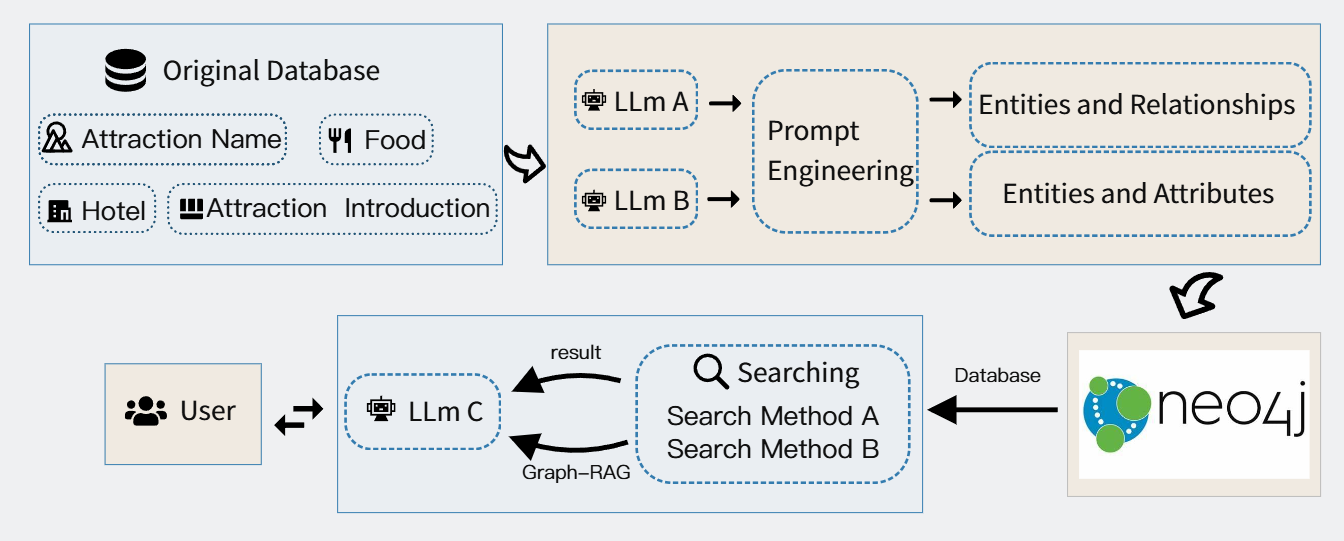
In collaboration with Professor Wang, I continued research on a project aimed at integrating knowledge graphs with LLMs to address the hallucination problem. Our goal was to transform the “black box” logic of LLMs into a more interpretable “white box” system, where users could understand how the model reaches its conclusions.
By leveraging Microsoft’s prompt engineering techniques, we automatically generated knowledge graph triples based on Tibetan tourist attractions. I developed a function-calling LLM mechanism that accurately extracted triple keywords from user queries, improving extraction accuracy by 7% compared to a fine-tuned LLM.
We also built two retrieval engines for the knowledge graph: logical chain retrieval and multi-node brute-force retrieval. A user survey of 100 participants revealed that Graph-RAG, when combined with the logical chain retrieval engine, resulted in a 60% higher user preference than the baseline LLM.
Our research shows that integrating knowledge graphs with LLMs significantly reduces hallucinations and enhances user satisfaction by making the reasoning process more transparent. Moving forward, I plan to refine our knowledge graph construction and retrieval methods to further improve LLM performance across various domains. Paper will be coming here!